Governance-aware delivery · with independent verification

Governed software delivery,
at AI speed.

AI writes code fast. HalaBrain is being built to make that speed safe to ship — it governs the delivery loop around a swappable AI executor and independently re-runs the tests and re-checks the rules against the real changed code. The core loop works today; the deeper governance is taking shape.

See how it works ↓
Core loop built & running 11-role AI team Early & evolving
Why this matters

AI agents ship code in minutes. But left ungoverned they drift, over-engineer, duplicate, and work out of context — fast in the wrong direction.

drift → grounded over-engineering → minimal-correct duplication → reuse silent passes → fail-closed self-reports → re-verified

HalaBrain's north star is to solve the LLM memory & context problem: keep agents anchored to the always-current ground truth — the code, the knowledge vault, the rulebook, and the gates — so what gets built is what was actually asked for, and provably so.

The mission

A multi-tenant platform that keeps AI agents grounded in the truth.

Plug in your code and your governing documents. AI turns both into a living, anti-drift knowledge base; every rule links to an approval gate routed to a responsible role; and when development runs, coordinated agents enforce every gate so nothing ships without the right approvals — while keeping concurrent users from colliding.

That's the destination. Today the engine, the governed loop, multi-tenant tenancy, and the governance spine already exist; the anti-drift, retrieval, and quality work around them is still ahead. This page shows exactly how far along each piece is — nothing more.

01

Comprehend

Read a codebase and produce the structured vault + the rules already embedded in the code. (Built.)

02

Author

Upload regulations, governance, and strategy; they become the per-tenant rulebook and references. (Built — SP-3. Design files from Figma still planned.)

03

Govern

Every rule links to an approval gate assigned to a role — AI suggests, the admin confirms. (Built — SP-3.)

04

Develop

Aware agents enforce every gate and never collide on the same files. (Loop built; locking + tenancy ahead.)

How it works

How the Brain works — the whole idea, in one governed loop.

AI writes code fast. HalaBrain makes that speed safe to ship. Step through the idea — from the problem, to the ideal, to the governed loop that proves it.

01 · The problem

AI ships code in minutes — ungoverned, it drifts.

Left unchecked, agents over-engineer, duplicate, and work out of context — fast in the wrong direction.

Shows the canonical happy path; opt-in clarification parks and off-path outcomes (rejected / needs-attention) are omitted for clarity. Stage names are the real lifecycle stages.

Architecture

Three components. One governed flow. All on the model layer.

Governance grounds the Brain; the Brain decides and verifies; the plugged-in targets act — and every layer runs on a swappable LLM. Hover a component, or trace a change end‑to‑end.

Hover a component to see what it does — or trace a change end-to-end.

hover / focus a component · click a model provider to swap it · ▶ trace a change

Knowledge & Governance · what grounds it

Knowledge & Governance

The living truth + the rules the Brain is bound by.

Knowledge Base
Code-synced comprehension vault + versioned baseline.
Rulebook
Governance rules + severities (hard / soft), per project.
AI Contracts
Per-role standing instructions that steer the agents.
Governance policy
Autonomy, objectives & approval routing — who must approve what.
grounds & governs
grounds decisions
baseline++ · KB re-scan
The Brain

Decides · acts · verifies

Owns the decisions and the state — never edits code itself.

◱ Impact analysis blast radius · rules triggered
◇ Intake gate approve the intent
⇄ Orchestration typed work order → executor
✓ Independent verification re-runs tests · re-checks rules
◇ Acceptance gate approve the real diff → merge
the decision core
◇ gated work order
diff · tests → ◇ gate
Plugged-in targets · behind adapters

Repos & deploys

The real world the change lands in — swappable.

Repositories
VC adapter (GitHub / GitLab) — branch & PR, never the trunk.
Deployment env
Deploy adapter — non-production only, live output captured.
Executor
Single agent or 11-role team — writes the code on a branch. Gated: nothing merges to trunk until the acceptance gate passes.
behind swappable adapters
LLM layer · adapter
every component runs on it — provider is swappable

The Brain writes no code — it dispatches a gated work order. No code is written until the intake gate approves the intent; nothing merges until the acceptance gate re-verifies the real diff.

System nerve center

The whole system as one live map.

Every subsystem and the typed contracts that pass between them — grounded, gated, built, and on the roadmap. Pan, drag, click a component, or ▶ trace a change.

See it

The real thing: the control room and the knowledge vault.

Two views from the system as it exists today — a governed change moving through the pipeline, and the code-synced Obsidian vault that keeps the agents grounded. Real stages, real checks, real notes.

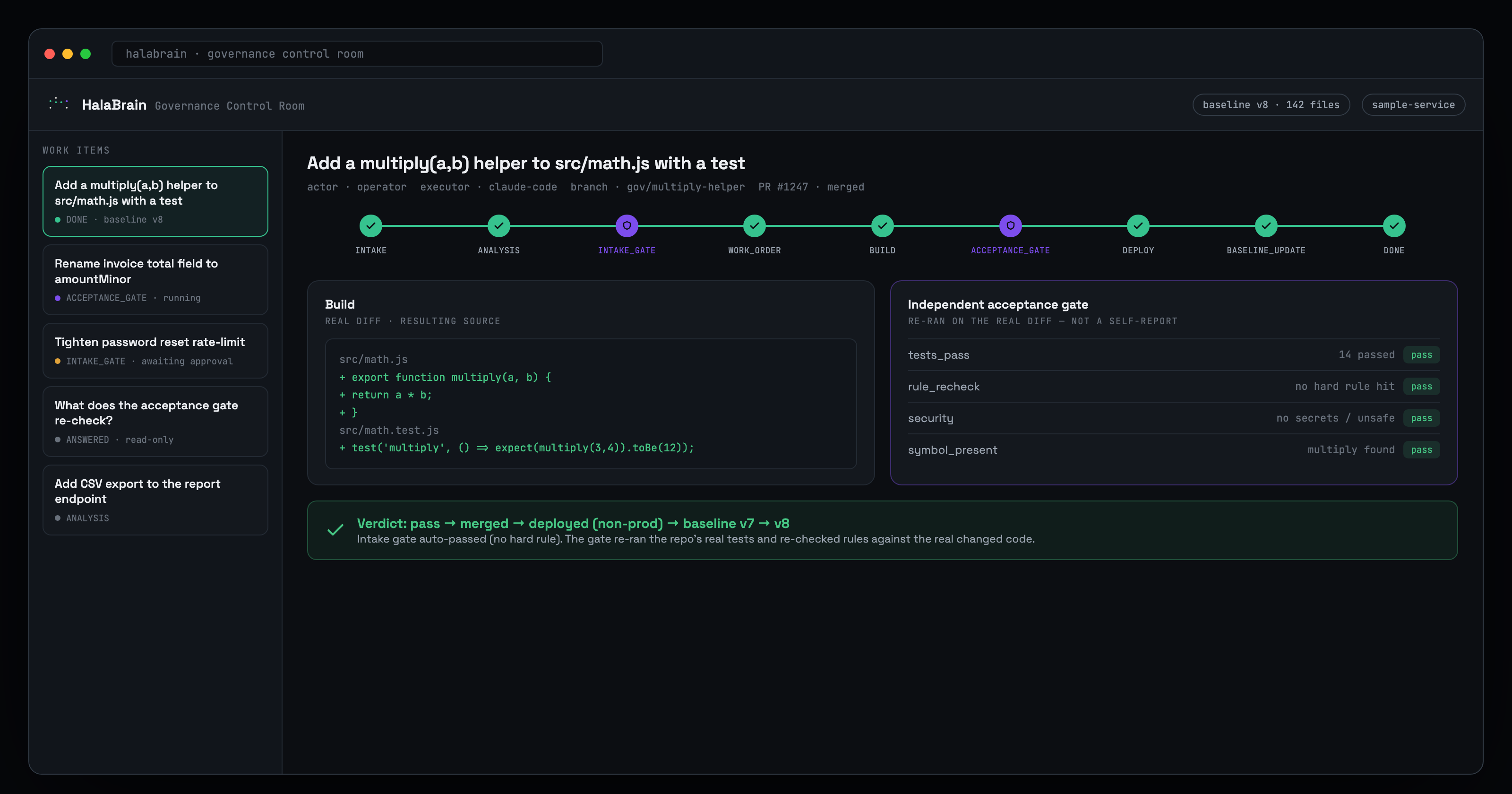
The HalaBrain control room: a work item moving through the governed lifecycle — intake, analysis, the intake gate, build with a real diff, the independent acceptance gate re-running real checks, deploy, and a baseline bump — ending in a pass verdict.
The control roomgoverned loopA change from intake to a verified, deployed baseline — the intake gate, a real diff, and the independent acceptance gate re-running the real tests and checks.
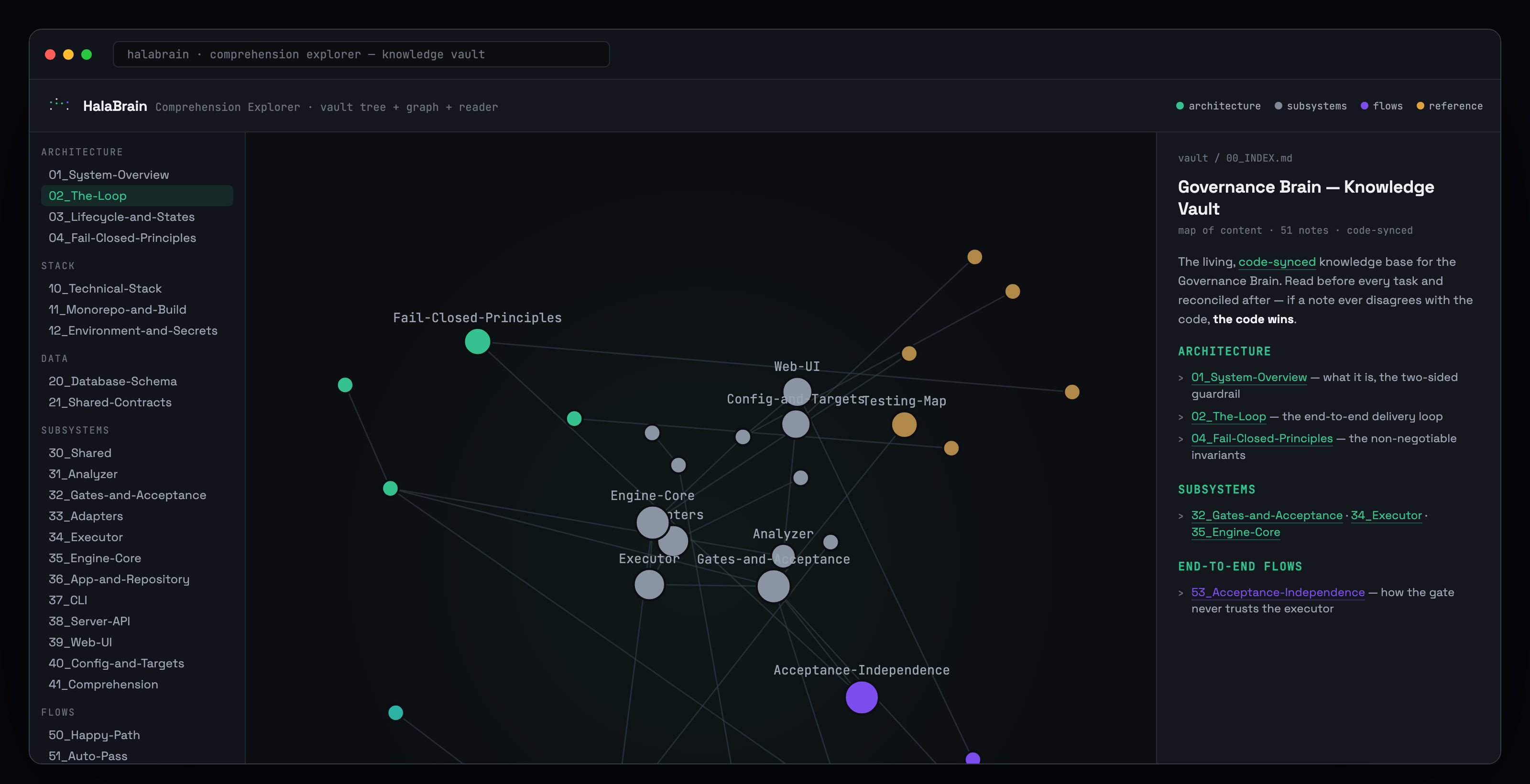
The HalaBrain comprehension explorer: a file tree of the 51-note knowledge vault, a force-directed graph of the notes and their links coloured by tier, and a reader pane showing the vault index with wikilinks.
The knowledge vaultanti-driftThe code-synced Obsidian vault — tree, link graph, and reader. Read before every task, reconciled after; when a note and the code disagree, the code wins.
The goals we're building toward

Speed, cost, quality, pipeline, governance — the dimensions we're solving for.

Speed

Agent-fast

The build is delegated to an AI executor that branches, codes, and opens a PR — minutes of work, not days.

Cost

Right-sized

Intent modes mean a question can stay a question — only real builds spin up the team, not every message.

Quality

Re-verified

Results are independently re-tested and re-checked against the real diff before they're accepted — the part that works today.

Pipeline

One queue

A single governed lifecycle from requirement to deployed baseline, with every state visible and persisted.

Governance

Foundation laid

On doubt the gate blocks or asks for approval. The richer, dynamic, tenant-defined governance is still being built.

Honestly: the verified core loop delivers the first dimensions today. The deepest one — rich, dynamic governance — is a foundation we're still hardening, not a finished claim.

What's inside

The capabilities that make AI coding governable.

Independent verification

The acceptance gate is the heart of the system. It re-runs the project's real test suite and re-checks the governance rules against the real changed code — never trusting the executor's own word, including our own team's reviewer.

FR-19 · NFR-3 · fail-closed

The Vault — anti-drift knowledge

A code-synced Obsidian knowledge vault is the living ground truth: architecture, contracts, flows, and a requirement map. It's read before every task and reconciled after — when a note and the code disagree, the code wins and the note is fixed.

bidirectional · always-current

Knowledge base & rulebook

Today, governance rules live as editable config and drive the gates by keyword, path, and content. The richer, per-tenant tag-ontology rulebook with approval routing and an authoring UI is designed but not built yet — it's the next big piece, not a current capability.

today: rules-as-config · richer: planned

Multi-agent orchestration

Behind the unchanged executor seam, a deterministic leader decomposes one work order across up to 11 specialist AI engineers, runs them in isolated git worktrees in parallel, and returns one build on one branch. Any role failure fails closed to an explicit decline.

11 roles · worktree-parallel

Multi-tenant foundation

The data foundation is in place: row-level tenant isolation in three layers (application filters, Postgres RLS, an adversarial proof suite) and a capability-enum identity model. Auth (email + emailed-OTP) is built but not yet merged or switched on; the full tenant experience is still ahead.

SP-1 · foundation laid, auth landing

Adapters everywhere

Version control, deploy target, LLM provider, and the executor itself sit behind swappable interfaces. The design intent is that new backends plug in behind the seam without touching the governed core — proven by the seams, not yet by a marketplace of integrations.

design intent · seam-isolated
Multi-agent orchestration

A whole engineering team — orchestrated, governed, and verifiable.

A product lead decides who's needed from the analysis. Foundation roles go first, implementers build in parallel isolated worktrees, and the verification layer runs serialized to avoid conflicts. The leader's own reviewer is extra diff — never a gate. The independent acceptance gate still re-runs everything.

Product
leads & selects
Architecture
contracts & seams
DB
migrations & data
Backend
engine & API
Frontend
UI & brand
SRE
deploy & resilience
Designer
UX & visuals
Security
secrets & scans
QA
tests & edges
Reviewer
two-stage review
Release
ship & deploy

Decomposed, isolated, reconciled.

One work order in, one build on one branch out. The conversation is fully observable — every plan, instruction, and agent message is streamed live into a read-only timeline, with zero weight on the gate.

  • Deterministic leader — picks roles from the analysis, not at random.
  • Parallel worktrees — implementers build in isolation; conflicts are prevented by file-ownership partitioning.
  • Serialized verification — designer → security → QA, so no two writers collide.
  • Fail-closed — any timeout, unsafe path, or merge conflict becomes an explicit decline, decided by reading back real git.
  • Designer × Figma · planned — the designer agent will build UI against the real Figma design system, not a guess.
Backends & adapters

Runs on a small, fixed set today. No connector marketplace yet.

Version control, deploy, the LLM, and the executor each sit behind an adapter. Today the system is wired to a handful of backends through configuration — there is no connectors UI and no setup wizard. Everything in the second group below is a direction the architecture allows, not a shipped integration.

In use today (via config) Possible via the adapter seam — not built yet
GitHub
version control · real PRs via gh
Railway
where this runs · hosting
Anthropic · Claude
the only LLM + executor today
PostgreSQL
datastore
Local non-prod runner
deploy · non-production
OpenAI · Codex
future LLM adapter · not built
Google · Gemini
future LLM adapter · not built
GitLab
future VC adapter · not built
AWS
future deploy target · not built
Oracle Cloud
future target · not built
Alibaba Cloud
future target · not built
Figma
design source · not built
MCP connectors
future · not built

To be clear: only GitHub, Railway, Anthropic Claude, PostgreSQL, and the local non-prod runner are actually wired right now — and they're configured in code/env, not through any in-product connector flow. Codex, Gemini, GitLab, AWS, Oracle, Alibaba, MCP, and Figma (a planned design-source integration) are planned directions the adapter seam is meant to make easy later — none of them is built. We don't stub things as real: an adapter that can't do something declines explicitly.

Milestones · the foundation

What's actually built: the core governed loop, in small reviewable phases.

The engine was built across seven phases — each runnable, tested, with a one-command demo and a review pause. On top of it, a series of sub-projects hardened execution and added the AI team and the comprehension vault. This part is real and merged; it's the ground the platform work below is being built on.

Core loop · Phases 1–7 · merged

P1 · Read-only analysis

merged

Knowledge base + baseline + impact analysis + report.

P2 · Intake gate & lifecycle

merged

Approval gating with persisted work-item lifecycle.

P3 · Work order & executor seam

merged

Typed contract + the swappable executor interface.

P4 · Real executor

merged

Headless Claude Code → real diff + real PR.

P5 · Independent acceptance gate

merged

Real tests + rule re-check + security/static on the real diff.

P6 · Gated non-prod deploy

merged

Deploy + close the loop with a baseline re-scan.

P7 · Control room UI + API

merged

The Fastify API + the React dashboard.

Sub-projects · on top of the loop · merged

Execution resilience

merged

Interrupted runs park & recover; deploy failures stay recoverable, never silently "done".

Multi-agent team

merged

The governed AI engineering team behind the executor seam.

Interactive intake & intent modes

merged

Ask / Plan / Build — a question can stay a question; clarify before building.

Codebase comprehension

merged

Polyglot scan → anti-drift Obsidian vault, generated & governed.

Comprehension Explorer & conversation viewer

merged

Read-only in-app vault browser + live team-conversation timeline.

Milestones · the platform plan

The plan: seven sub-projects, ~29 reviewable phases, built strictly in order.

The mission turns the single-tenant engine into a multi-tenant governance platform. It's decomposed into seven sub-projects (SP-1 → SP-7, the last being requirements-grounded conformance) and ~29 small phases — each one runnable, tested, and reviewed before the next. Statuses here are honest: SP-1, SP-2, and SP-3 are all merged; the rest are designed or planned, not built.

mergedbuilt / in progressplanned — not built
SP-1

Tenancy, identity & role registry

merged

The foundation everything depends on: close the open app with auth; tenant / project / user / membership / role data; row-level tenant_id isolation across every table; a tenant-defined role registry over a capability enum.

1.1 Contracts + schema 1.2 Auth + session 1.3 RBAC + role registry 1.4 Per-tenant engine / config 1.5 Web (login + switcher + admin)
SP-2

File-locking & collaboration

merged

Stop two people / agents building on overlapping files: path-level leases with an early predictive block and a hard backstop at the real git diff (conflicts prevented, not patched), plus per-project concurrency.

2.1 Lease contracts + store 2.2 Acquire at analysis + early block 2.3 Real-diff backstop 2.4 Lifecycle + concurrency 2.5 Web (lock / conflict UI)
SP-3

Governance engine + approval routing + authoring UI · the spine

merged

Replace today's regex rules with a real tag-ontology rule engine: a layered framework + an AI classifier, deterministic approval routing to accountable roles (SoD / maker-checker), the AI Development Contract, and an AI-suggest / admin-confirm authoring UI. This is the heaviest sub-project — and where "tight, dynamic governance" actually gets built.

3.1 Rule-model contracts 3.2 Baseline tagging 3.3 Tag-match gate 3.4 Approval routing 3.5 Layered framework + AI classifier 3.6 AI Development Contract 3.7 Authoring UI
SP-4

Anti-drift, bidirectional

planned

Keep code + vault + rules mutually current in both directions: a code change that leaves a note stale — or a rule edit that diverges from the code — becomes a routed finding (warn + approve), and an accepted drift regenerates only the affected notes.

4.1 Drift → finding 4.2 Route + resolve 4.3 Targeted note regeneration
SP-5

Token-minimal retrieval · spec merged

planned

Keep agents grounded cheaply: a deterministic per-project manifest behind a retrieval adapter feeds a session only the few notes and files it actually needs. No vector store, no embeddings RAG — exact structured lookup, an optional adapter swap if ever needed.

5.1 Manifest + adapter 5.2 Expose + measure
SP-6

Quality & feedback · spec merged

planned

Make it measurably good and improving — without any model fine-tuning: an evaluation harness that scores extraction / classification / routing accuracy, and a deterministic suggestion-feedback loop. The gate and independent verification are never an input or output of it.

6.1 Evaluation harness 6.2 Suggestion-feedback loop 6.3 Independence proof + dashboard
SP-7

Requirements-grounded conformance · intent & scope governance

planned

Give the system's own reverse-engineered requirements and past gate decisions a governance role at intake: when a work order looks out of scope, a duplicate, or a contradiction of a grounded invariant, it escalates to a human — never auto-blocking, never touching the independent acceptance gate. Fail-closed and opt-in, so an area with no grounded requirement is never silently passed. Newest direction on the plan; nothing here is built yet.

7.1 Intake conformance verdict 7.2 Cross-build precedent 7.3 Decision-mining → rule proposals 7.4 Governance-memory view
Easy, governed development — everywhere

Governed on the web today. Mobile is next.

Today

Web

The current interface is a web dashboard — submit a requirement and follow it through analysis, the gates, the build, independent acceptance, the deploy, and the baseline. It's early, but the loop runs end to end on the web today, showing real diffs and real output rather than status text.

The principle we build by

AI suggests. The human confirms.

The system proposes; an authorized human disposes. Speed comes from the AI, trust from the governance — and getting that balance right, dependably, is exactly the work still in progress.

An honest work in progress.

A working core loop with independent verification and an AI team, an honest roadmap for the governance, collaboration, and integrations still ahead — and a commitment to never claim more than is actually built.